

Learn about S corporation benefits for US businesses, from tax savings on self-employment to asset protection and operational flexibility. Get practical insights.
For many small and medium-sized businesses in the US, choosing the right legal structure is a crucial decision with lasting implications. From years of advising clients, I’ve seen firsthand how an S corporation election can significantly impact a business’s financial health and operational ease. It’s not merely a tax election; it’s a strategic move designed to provide specific advantages over a traditional sole proprietorship or partnership, particularly regarding tax liabilities and owner compensation.
Overview
- S corporations allow businesses to avoid the double taxation common with C corporations.
- Owners can potentially reduce their self-employment tax burden on distributions.
- The structure provides a clear separation between personal and business liabilities.
- It often enhances a business’s credibility and perceived professionalism.
- Shareholder wages must be reasonable and market-based, preventing abuse.
- Profit distributions are not subject to payroll taxes.
- The pass-through nature simplifies tax reporting for owners.
- S corps offer flexibility in ownership transfers and fundraising.
Understanding the Tax Advantages: Key S corporation benefits
One of the most compelling S corporation benefits revolves around its unique tax treatment. Unlike a C corporation, an S corporation is a pass-through entity. This means the company itself doesn’t pay federal income tax; instead, profits and losses are “passed through” directly to the owners’ personal tax returns. This structure entirely bypasses the issue of double taxation, where C corporations pay tax on their profits, and shareholders pay tax again on dividends.
From a practical standpoint, this can lead to substantial savings. For instance, a business owner operating as a sole proprietor or partner pays self-employment tax (Social Security and Medicare) on all their business income. With an S corp, owners can be paid a reasonable salary, subject to payroll taxes, and then receive the remaining profits as distributions. These distributions are generally exempt from self-employment taxes, providing a significant financial advantage. I’ve seen this strategy save business owners thousands of dollars annually, especially as their profitability grows. Careful planning with a qualified accountant is essential to determine reasonable compensation.
Owner Compensation and Distributions for S Corps
Operating an S corporation requires adherence to specific rules, particularly concerning how owners are compensated. The IRS mandates that S corporation owners who actively work for the business must receive a “reasonable salary.” This salary is subject to regular payroll taxes, including Social Security and Medicare. What constitutes “reasonable” depends on the industry, geographic location, experience, and services performed. It should align with what similar professionals would earn in a comparable role.
Once a reasonable salary is paid, any additional profits can be distributed to shareholders as dividends. A crucial aspect here is that these distributions are not subject to self-employment taxes. This distinction is one of the primary drivers for many small business owners in the US to elect S corporation status. For example, if a business earns $150,000 and the owner takes a $70,000 salary, the remaining $80,000 can be distributed without incurring the additional 15.3% self-employment tax burden on that distribution. This setup requires disciplined payroll management and clear understanding of tax obligations.
Operational Flexibility and Business Credibility: Further S corporation benefits
Beyond the direct tax savings, other S corporation benefits contribute to a business’s long-term health and operational effectiveness. Opting for S corp status can often lend greater credibility to a business, particularly when dealing with lenders, investors, or larger clients. The formal structure suggests a more established and professionally managed entity compared to an unincorporated business. This perception can open doors to better financing options and more substantial contracts.
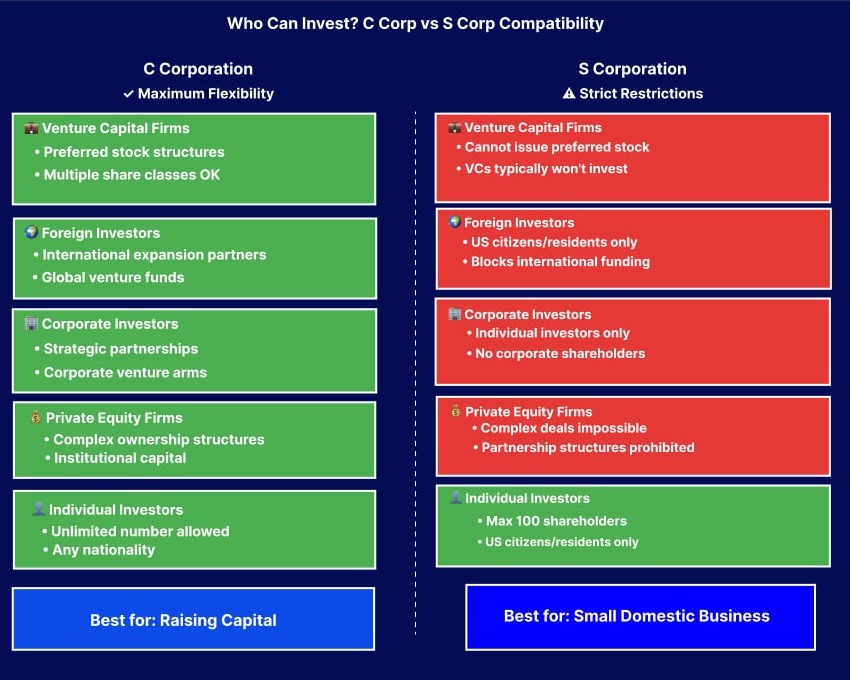
Furthermore, S corporations offer flexibility in ownership. While limited to 100 shareholders, these shareholders can be individuals, certain trusts, or estates, making it suitable for many family-owned or closely-held businesses. The structure also simplifies the process of bringing in new investors or transferring ownership compared to a partnership. This can be particularly useful for succession planning or future expansion. The clear division between owner and business, legally and financially, simplifies compliance and reporting for many owners.
Asset Protection and Long-Term Growth: Essential S corporation benefits
The protection of personal assets is another critical among the S corporation benefits. Like a C corporation or an LLC, an S corporation provides its owners with limited liability protection. This means that, in most cases, the personal assets of the shareholders (such as homes, cars, and personal savings) are shielded from business debts and legal claims. If the business faces a lawsuit or bankruptcy, the owners’ personal wealth is generally protected, limited only to their investment in the company.
This layer of protection offers immense peace of mind and fosters a more secure environment for business growth and risk-taking. It allows entrepreneurs to invest confidently in their ventures without fear of losing everything they own personally. From experience, ensuring this separation is clear and maintaining corporate formalities are vital to uphold this protection. Neglecting these aspects, like commingling personal and business funds, can lead to “piercing the corporate veil,” nullifying this crucial benefit. Properly structuring an S corp is a proactive step toward safeguarding both the business and the owner’s financial future.